
If you are evaluating LED displays for a critical project, the debate between COB (Chip on Board) and SMD (Surface-Mounted Device) is the most consequential technical decision you will make. While standard specification sheets highlight brightness and pixel pitch, they often obscure the long-term realities of thermal management, failure rates, and maintenance costs.
As a direct manufacturer engineering cutting-edge micro-LED displays, we look beyond the sales brochure. This comprehensive guide—designed for AV integrators, CTOs, and high-end buyers—deconstructs the technology, reveals industry secrets, and provides a definitive framework for achieving the highest Return on Investment (ROI).
1. What is the Difference Between SMD and COB LED
To make an informed purchase, you must understand the microscopic architecture of these panels. It is not just about how they look; it is about how they are packaged.
🔹 SMD: The Traditional Point Source
SMD stands for Surface-Mounted Device. Individual LED chips (Red, Green, Blue) are wire-bonded inside a tiny plastic cup to form a single pixel. This pixel is then soldered onto the PCB using four microscopic metal legs.
The Limitation: These raised physical components are exposed to air, moisture, and physical impact, acting as individual “point” lights that can cause pixelation at close distances.
🔹 COB: The Integrated Surface Source
COB stands for Chip on Board. Instead of separate brackets, hundreds of naked LED dies are directly bonded to the PCB. The entire board is then encapsulated under a continuous layer of protective epoxy resin.
The Evolution: Modern Flip-Chip COB completely eliminates gold wire bonding, resulting in a smooth, screen-like “surface” light that is virtually indestructible.
💡 Industry Insight: What about GOB and MIP?
Many buyers confuse COB with GOB (Glue on Board). GOB is simply a traditional SMD screen covered in a layer of glue for protection—it is a transition technology. Meanwhile, MIP (Micro LED in Package) is an emerging hybrid offering COB-level chips with SMD-style repairability. When discussing ultra-fine pitches, genuine COB remains the current gold standard.
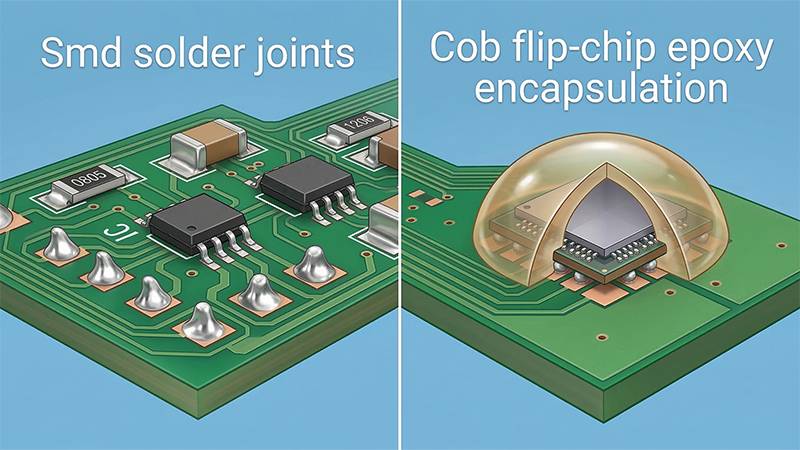 [ Microscopic Packaging Cross-Section ]
2. SMD vs. COB Performance Comparison
Moving beyond marketing terms, here is how the two technologies perform across six critical environmental and visual stress tests:
-
🛡️ Physical Durability & Protection
SMD: Highly susceptible to physical bumps. A light scrape from equipment can dislodge pixels, leading to immediate “dead light” maintenance.
COB: Military-grade resilience. The resin coating provides 5X the impact resistance of SMD. It is naturally IP65 waterproof on the front, dustproof, and anti-static. -
👁️ Visual Comfort & Optical Quality
SMD: Point-source light can cause significant eye strain in control rooms or classrooms. Cameras easily pick up moiré patterns (wavy lines) from the pixel grids.
COB: Delivers a diffuse, soft-surface light. It eliminates glare, reduces eye fatigue for 24/7 operators, and is 100% moiré-free for broadcast studios. -
🌡️ Thermal Management (Heat Dissipation)
SMD: Heat is trapped within the plastic cup and must travel a long path through the solder legs. Screens run noticeably hotter.
COB: Because chips are bonded directly to the PCB, heat transfers instantaneously to the board, lowering the core temperature and extending the lifespan of the display.
3. Insights from Display Manufacturers
To ensure you are fully equipped, we must discuss the manufacturing realities of COB. It is a premium technology, but it has specific pitfalls that unverified suppliers will not mention.
- The “Ink Color” Consistency Trap: Because COB panels are coated in resin, achieving the exact same shade of black across hundreds of modules is notoriously difficult. If you buy from a cheap supplier, your screen will look like a patchwork quilt when powered off. Solution: Mandate strict optical calibration and single-batch delivery.
- The Repair Reality: If an SMD pixel dies, a local technician can solder a new $0.10 bulb in minutes. If a COB pixel dies, it cannot be fixed on-site. You must swap the entire module and ship it back to the factory. While COB fails far less often (under 10 PPM), when it does, the logistics are heavier.
4. Display pixel pitch selection
Your required pixel pitch (the distance between LEDs) will largely dictate which technology you should buy. Use this manufacturer’s framework:
5. Display screen procurement cost analysis
Amateur buyers look at the initial invoice; professional buyers look at the 3-Year TCO. Because of its superior energy efficiency (Flip-Chip) and near-zero maintenance, COB often pays for its initial premium within 24 months.
| Financial Metric (3-Year Span) | SMD LED Example | COB LED Example | Financial Winner |
|---|---|---|---|
| Initial Hardware CapEx | Baseline Cost | Premium (15-20% Higher) | SMD |
| Energy / HVAC OpEx | Standard Draw & Heat | Up to 30% Savings | COB |
| Maintenance & Downtime | High (Pixel Soldering) | Near Zero | COB |
| Lifespan Degradation | Noticeable after 3-4 years | Highly stable & sealed | COB |
6. Final Verdict: Which One Should You Buy?
- Outdoor Billboards and Facades
- Stage, Touring, and Rental Events (Flexible curving and field repair)
- Large Auditoriums (Viewing distance > 15 feet)
- Strictly constrained initial capital budgets
- Mission-Critical Control & Command Centers
- High-End Corporate Boardrooms & TV Studios
- Interactive zones, schools, and museums (Touch-safe)
- Projects demanding ultra-fine pitches (Below P1.2)
Need expert advice for your specific architectural blueprint?
As a direct manufacturer, our engineering team can provide a free, customized TCO calculation and recommend the optimal pixel pitch for your space,Contact our technical department today.