
The Definition of COB
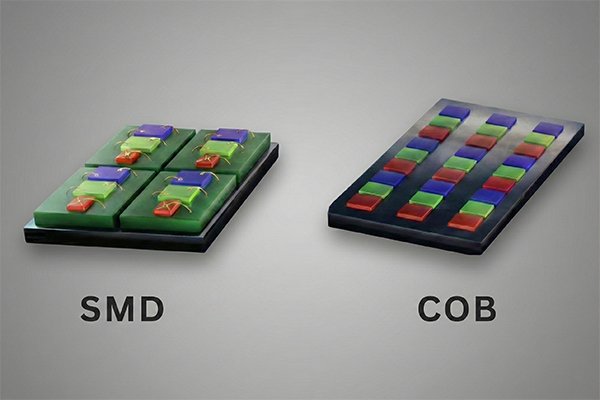
COB stands for Chip-on-Board. It is an advanced LED packaging technology where multiple bare LED chips are bonded directly onto a substrate (or circuit board) to form a single module.
Unlike traditional packaging (where chips are placed in a cup and covered with phosphor), COB technology eliminates the intermediate packaging step. The chips are covered with a layer of epoxy or silicone resin, which acts as a protective shield and aids in light diffusion.
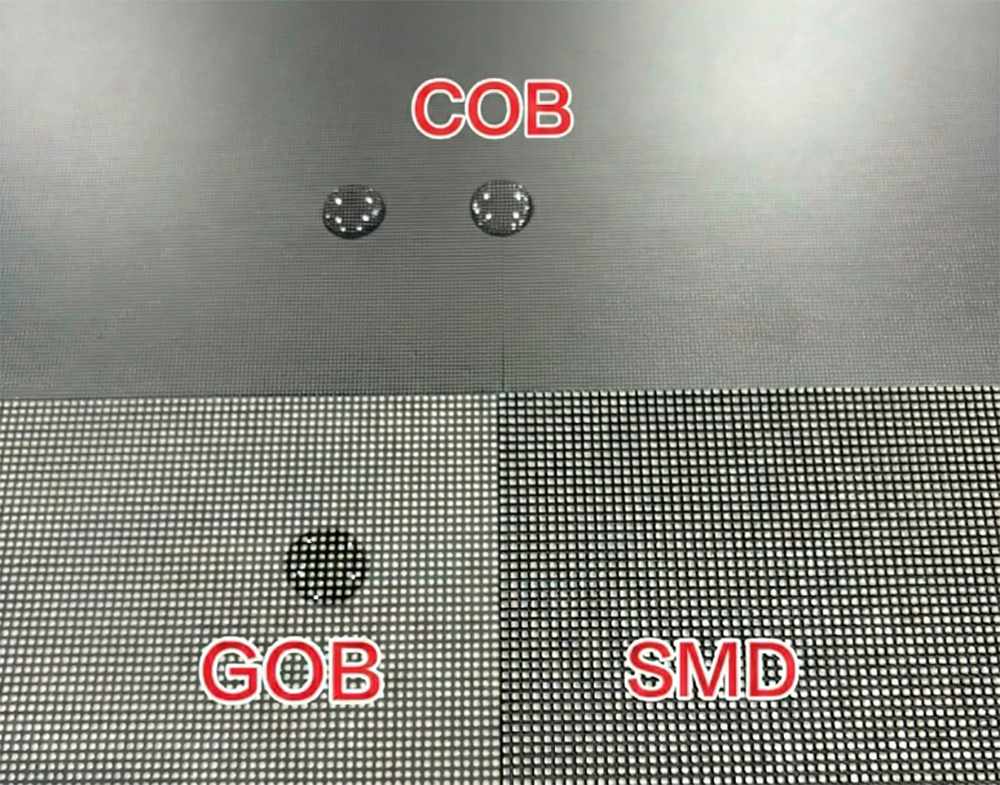
COB vs. SMD: What’s the Difference?
| Feature | SMD (Surface Mounted Device) | COB (Chip on Board) |
|---|---|---|
| Structure | Chip inside a casing/reflector | Chip directly on PCB |
| Light Quality | Can have visible dots (pixelation) | Smooth, uniform, glare-free |
| Durability | Pins can be fragile | High (Dust/Moisture/Collision proof) |
| Primary Use | General lighting, Standard displays | Fine-pitch displays, High-bay lights |
Why COB is the King of Indoor Displays
As shown in the image, COB technology is revolutionizing Indoor LED Displays. Because there are no geometric limitations of individual brackets, the pixel pitch can be incredibly small (below P1.0).
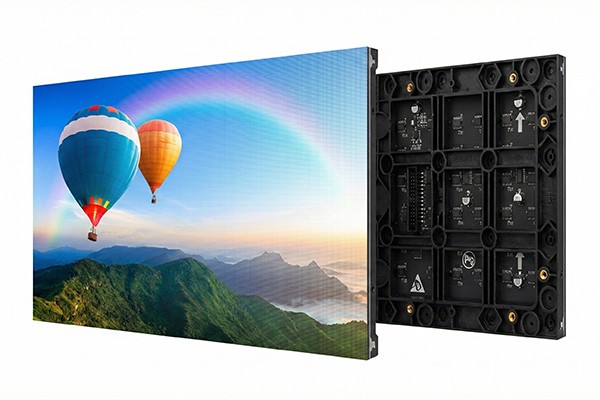
*Typical Fine-Pitch Indoor COB Display Cabinet
Key Benefits for Screens:
Frequently Asked Questions
Is COB LED better than LED?
COB is a type of LED. However, compared to older DIP or SMD LEDs, COB is generally better for high-density lighting and compact displays due to better thermal efficiency and light uniformity.
What is the lifespan of COB LED?
Due to superior heat dissipation (the chips are directly bonded to the heat sink substrate), COB LEDs often have a longer operational lifespan, frequently exceeding 50,000 to 100,000 hours.
Can COB LEDs be dimmed?
Yes, COB LEDs are fully dimmable, provided they are paired with a compatible driver (DALI, 0-10V, or Triac).