
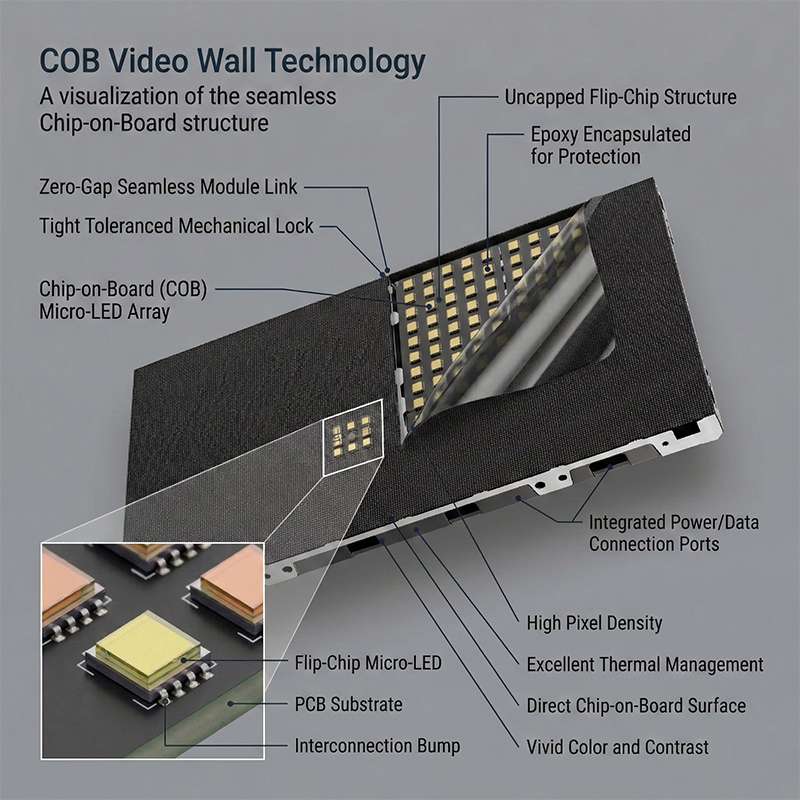
A COB (Chip-on-Board) LED wall represents the latest evolution in Large-format display technology. Unlike traditional SMD (Surface Mounted Device) screens where individual LED diodes are soldered to a circuit board, COB technology involves mounting multiple LED chips directly onto a substrate to form a single module.These chips are then encapsulated with a specialized transparent resin or coating. This creates a seamless, “pixel-free” appearance with a continuous light-emitting surface, offering significantly higher pixel density and durability than previous generations.
Key Advantages of COB LED Technology
1. Ultra-Fine Pixel Pitch
COB allows for incredibly small spacing between pixels (often below 0.9mm). This makes it the gold standard for high-definition 4K and 8K indoor displays where viewers are close to the screen.
2. Superior Durability (4H Protection)
The resin encapsulation makes COB walls waterproof, dustproof, and anti-collision. You can touch the surface without damaging the tiny LEDs, which is a major weakness of traditional SMD screens.
3. Wider Viewing Angles
Because the light source is flatter and not blocked by a “bracket” or package, COB walls offer nearly 180-degree viewing angles with no color shift or brightness loss from the sides.
4. Better Heat Dissipation
Heat is dissipated directly through the substrate rather than through an LED package. This keeps the wall cooler, extending the lifespan of the components and improving energy efficiency.
Strategic Application Fields
From high-stakes command centers to immersive home cinemas, COB LED walls are replacing LCD video walls and SMD LEDs in premium environments.
| Industry | Primary Use Case | Why COB? |
|---|---|---|
| Control Rooms | Security, Traffic Management, Power Plants | High reliability, 24/7 operation, and sharp text readability. |
| Corporate/Boardrooms | Video Conferencing & Brand Display | Seamless aesthetic and anti-glare properties. |
| Broadcasting | TV Studios & Virtual Production | Eliminates Moiré patterns during camera filming. |
| Premium Retail | Luxury Brand Stores & Showrooms | High contrast and vibrant colors attract foot traffic. |
COB vs. SMD vs. GOB: Which Should You Choose?
Understanding the technical differences is crucial for making an informed investment. While SMD has been the industry standard, COB and GOB offer enhanced protective features.
SMD (Surface Mount)
- Mature technology, lower cost.
- Vulnerable to physical impact.
- Best for P1.5 and above.
COB (Chip on Board)
- Highest reliability & protection.
- Best for Micro-pitch (P0.4-P0.9).
- Superior visual comfort & contrast.
GOB (Glue on Board)
- Protective layer added to SMD.
- Mid-range cost and durability.
- Maintains traditional SMD structure.
Professional Installation & Easy Maintenance
Deploying a COB LED wall requires precision. Most modern systems utilize Full Front Maintenance, allowing individual modules to be removed with vacuum tools without dismantling the entire structure.
- ✔ Structural Mounting: Custom frames ensure perfect flatness across large spans.
- ✔ Calibration: Advanced pixel-to-pixel calibration ensures color uniformity.
- ✔ Seamless Cleaning: Since the surface is flat resin, it can be wiped clean with a soft cloth.
Maintenance Pro-Tip:
Unlike SMD, COB surfaces are resistant to static and moisture. However, we recommend maintaining an ambient temperature between 18°C and 25°C for optimal lifespan and color accuracy.
How to Select the Right COB LED Wall
When requesting a quote for your project, consider these three critical factors:
- Viewing Distance: If your audience is within 1-2 meters, look for a pixel pitch of P0.9 or smaller. For larger auditoriums, P1.2 to P1.5 is often sufficient.
- Brightness Requirements: Standard indoor COB walls offer 600-1000 nits. Ensure the wall supports HDR10+ for the best dynamic range in varying lighting conditions.
- Refresh Rate: Look for a refresh rate of at least 3840Hz to ensure flicker-free viewing, especially if the screen will be filmed or used for video conferencing.
The Future of COB LED Walls
As manufacturing yields improve and production costs decrease, COB is expected to become the dominant technology for all indoor LED applications. We are seeing a shift toward MicroLED (an advanced form of COB) which offers even higher brightness and near-infinite contrast ratios. In the coming years, COB LED walls will likely enter the consumer market for high-end home theaters, replacing traditional projectors and large-screen TVs.
Frequently Asked Questions
What are the disadvantages of COB lights?
The primary disadvantage is the cost; COB technology is currently more expensive to manufacture than SMD. Additionally, because the chips are encapsulated together, repairing a single pixel can be more complex and usually requires replacing the entire module or using professional factory-grade equipment.
What does cob led mean?
COB stands for Chip-on-Board. It refers to the semiconductor packaging technology where LED chips are placed in direct contact with a substrate (like silicon carbide or sapphire) to produce LED arrays. It’s about density and direct integration.
How long does cob led last?
Most high-quality COB LED walls are rated for 100,000 hours of use. This means if you ran the wall 24 hours a day, it would last over 11 years. In a standard business environment, it can easily last 15-20 years with proper maintenance.
Do COB LEDs use more power?
Actually, COB LEDs are generally more energy-efficient. Because they have better heat dissipation and allow for a higher luminous efficacy (more light per watt), they often consume less power than traditional LED screens with the same brightness levels.