
Home / news / What is a COB LED?

What is a COB LED?

Table of Contents

The Definition of COB

COB stands for Chip-on-Board. It is an advanced LED packaging technology where multiple bare LED chips are bonded directly onto a substrate (or circuit board) to form a single module.

Unlike traditional packaging (where chips are placed in a cup and covered with phosphor), COB technology eliminates the intermediate packaging step. The chips are covered with a layer of epoxy or silicone resin, which acts as a protective shield and aids in light diffusion.
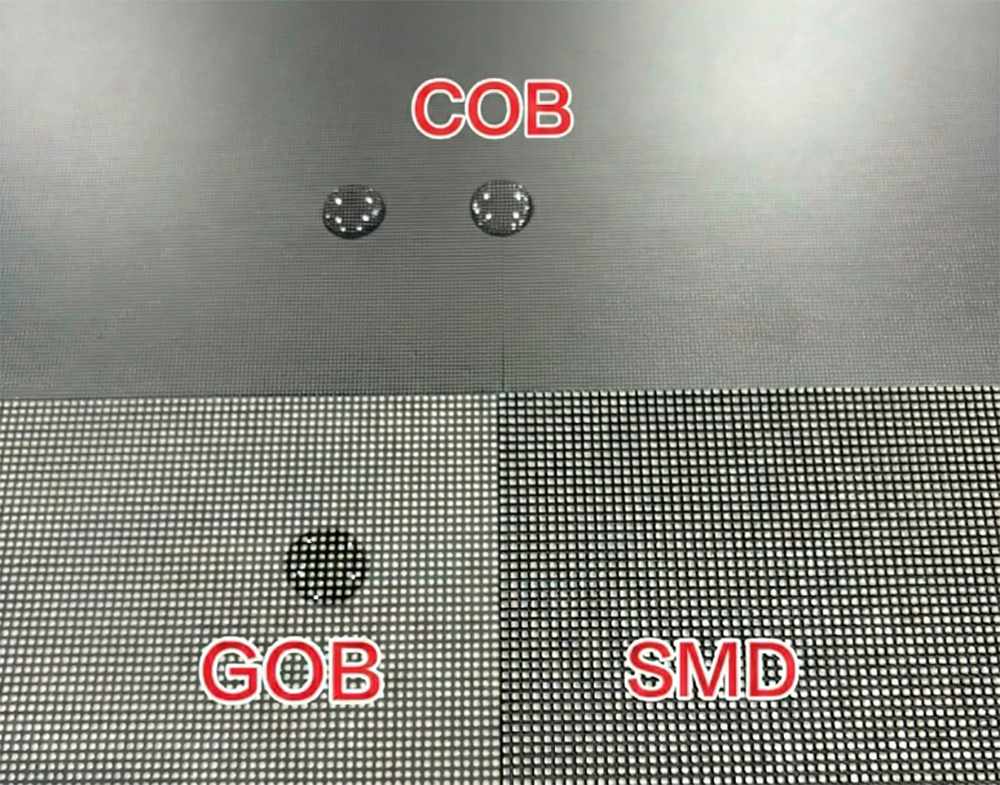
COB vs SMD LED structure comparison

COB vs. SMD: What’s the Difference?

Feature SMD (Surface Mounted Device) COB (Chip on Board)
Structure Chip inside a casing/reflector Chip directly on PCB
Light Quality Can have visible dots (pixelation) Smooth, uniform, glare-free
Durability Pins can be fragile High (Dust/Moisture/Collision proof)
Primary Use General lighting, Standard displays Fine-pitch displays, High-bay lights

Why COB is the King of Indoor Displays

As shown in the image, COB technology is revolutionizing Indoor LED Displays. Because there are no geometric limitations of individual brackets, the pixel pitch can be incredibly small (below P1.0).
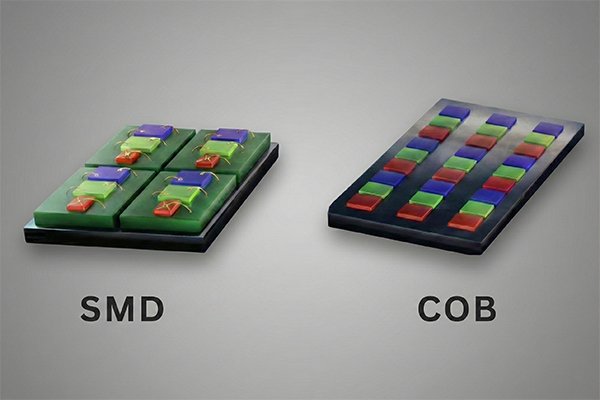
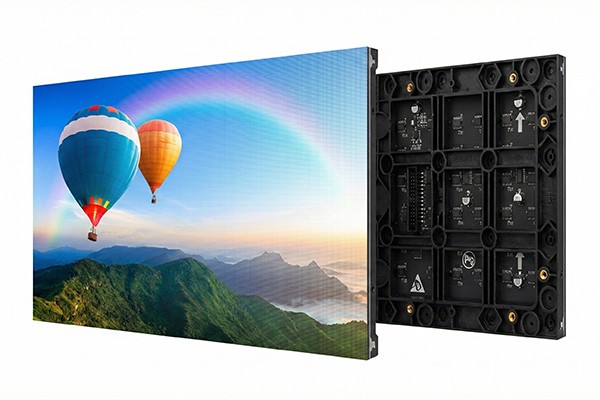
Diagram showing COB LED Structure with chips directly on board

Indoor COB LED Display Module showing high contrast and sleek design

*Typical Fine-Pitch Indoor COB Display Cabinet

Key Benefits for Screens:

1
Superb ProtectionThe surface is smooth and sealed. It is resistant to collision, water splashes, and dust, making it easier to clean than SMD screens.
2
Wider Viewing AngleCOB offers nearly 180° viewing angles with consistent color reproduction from any position.
3
Less Visual FatigueThe “planar” light source is softer on the eyes compared to the sharp “point” light source of traditional LEDs.

2026 Evolution: Full Flip-Chip COB

Full Flip-chip COB technology eliminates the primary cause of pixel failure by removing gold wire bonding.
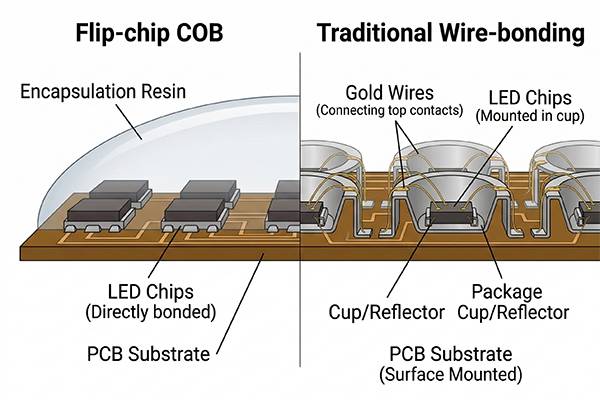
Flip-chip COB vs Traditional Wire-bonding LED structure

*Full Flip-Chip COB technology: No gold wires, higher reliability.*

Wireless BondingNo gold wires mean no breakage from thermal expansion. Stability increased by 200%.
Higher Aperture RatioFlip-chip allows larger light-emitting areas, reaching 2,000 nits without overheating.

Engineering Data: Cool to the Touch

Our 2026 Common Cathode driving technology sets a new benchmark for energy efficiency.
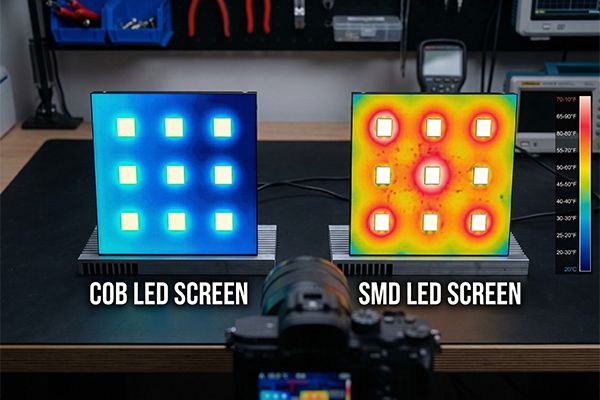
Thermal imaging comparison between COB and SMD LED screens

*Internal lab test: COB maintains significantly lower surface temperatures.*

-10°C
Lower Surface Temp
35%
Energy Saving

Is COB Repairable? The Truth.

A common myth is that COB is “disposable.” At YT LED, we’ve pioneered a 3-step restoration process that restores modules to factory standards.
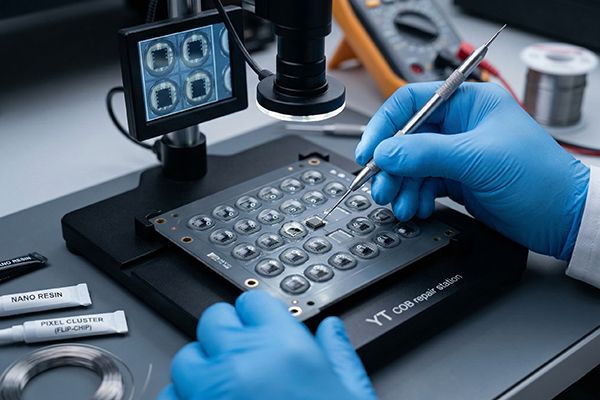
Professional COB LED module pixel-level repair process
  • Step 1: Localized thermal removal of defective pixel clusters.
  • Step 2: High-precision re-bonding using Nano-encapsulation kits.
  • Step 3: In-situ color recalibration for 99.9% visual uniformity.

Where COB Excels in 2026
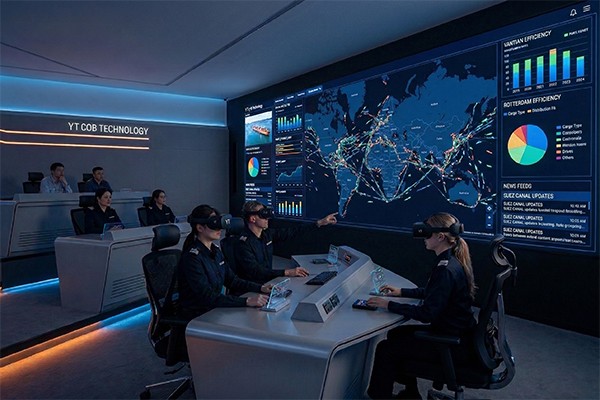
COB LED Wall in Control Room

Mission Critical Control Centers

24/7 reliability with anti-static and anti-collision surfaces. Flip-chip COB ensures zero downtime for high-traffic mission control environments.

XR Studio with COB LED Background

Virtual Production & XR Studios

Ultra-high 7680Hz refresh rates and deep black levels. COB provides the cinematic consistency required for seamless in-camera visual effects.

COB vs. MiP

While MicroLED (MiP) is emerging for ultra-high resolution, COB remains the gold standard for large-scale professional displays due to its proven balance of cost, yield, and durability.

Expert Tip: For P0.7 – P1.2 projects, COB offers the best ROI (Return on Investment) in 2026.

Expert Insights: COB LED Display FAQ

Why is COB LED display superior to SMD for fine-pitch?
+
The superiority of COB LED display technology in fine-pitch (below P1.2) stems from its “chip-on-board” structure. Unlike traditional SMD LED screens that rely on individual plastic brackets, COB bonds flip-chips directly to the PCB. This eliminates fragile solder pins and creates a seamless, robust surface. For high-end indoor LED walls, COB offers 10x higher reliability, superior thermal dissipation, and a much wider viewing angle.
Can a COB LED display module be repaired?
+
Yes. As a professional COB LED manufacturer, we utilize specialized nano-coating repair kits and module-level recalibration tools. If a pixel fails, our engineers use localized thermal removal to replace the specific micro-chip without damaging the surrounding resin. Once re-encapsulated, the module undergoes color matching to ensure 99.9% visual uniformity for your COB LED video wall.
How does COB improve contrast and black levels?
+
COB LED displays achieve industry-leading contrast ratios (up to 10,000:1) because the encapsulation resin is treated with advanced optical “deep black” coatings. Traditional SMD displays have reflective plastic brackets that interfere with black levels. COB’s planar light source and matte finish absorb ambient light, providing “true black” performance essential for XR virtual production.
Is it more energy-efficient than traditional LED?
+
Modern COB LED displays utilize flip-chip and common cathode driving. By removing gold wire bonding, energy is transferred with less resistance. Our energy-saving COB LED panels reduce power consumption by up to 35% and operate at surface temperatures 10°C lower than standard screens.
What are the differences between COB, GOB, and MicroLED?
+
GOB (Glue-on-Board) is just a protection layer over SMD. COB LED display is a true structural evolution where chips are directly integrated for better heat management. MicroLED is the future frontier, but in 2026, COB technology remains the most cost-effective solution for professional P0.7 to P1.5 micro-pitch LED projects.

Send Your Inquiry Today!


    滚动至顶部