
Se você estiver avaliando telas LED para um projeto crítico, o debate entre COB (Chip a bordo) e SMD (Dispositivo montado em superfície) é a decisão técnica mais importante que você tomará. Embora as folhas de especificações padrão destaquem o brilho e a densidade dos pixels, eles muitas vezes obscurecem as realidades de longo prazo do gerenciamento térmico, taxas de falha, e custos de manutenção.
Como fabricante direto, projetamos telas micro-LED de última geração, olhamos além do folheto de vendas. Este guia completo – projetado para integradores AV, Diretores de Tecnologia, e compradores sofisticados – desconstrói a tecnologia, revela segredos da indústria, e fornece uma estrutura definitiva para alcançar o maior retorno sobre o investimento (ROI).
1. Qual é a diferença entre LED SMD e COB
Para fazer uma compra informada, você deve entender a arquitetura microscópica desses painéis. Não se trata apenas de sua aparência; é sobre como eles são embalados.
🔹SMD: A fonte pontual tradicional
SMD significa dispositivo montado em superfície. Chips LED individuais (Vermelho, Verde, Azul) são ligados por arame dentro de um pequeno copo de plástico para formar um único pixel. Este pixel é então soldado ao PCB usando quatro pernas de metal microscópicas.
A limitação: Esses componentes físicos elevados são expostos ao ar, umidade, e impacto físico, agindo como indivíduo “apontar” luzes que podem causar pixelização em distâncias próximas.
🔹COB: A Fonte de Superfície Integrada
COB significa Chip a bordo. Em vez de colchetes separados, centenas de matrizes de LED nuas estão diretamente ligadas ao PCB. Toda a placa é então encapsulada sob uma camada contínua de resina epóxi protetora.
A Evolução: O moderno Flip-Chip COB elimina completamente a ligação de fios de ouro, resultando em uma suave, semelhante a uma tela “superfície” luz que é praticamente indestrutível.
💡 Visão do setor: E quanto ao GOB e MIP?
Muitos compradores confundem COB com GOB (Cola a bordo). GOB é simplesmente uma tela SMD tradicional coberta por uma camada de cola para proteção – é uma tecnologia de transição. Enquanto isso, MIP (Micro LED no pacote) é um híbrido emergente que oferece chips de nível COB com capacidade de reparo estilo SMD. Ao discutir arremessos ultrafinos, COB genuíno continua sendo o padrão ouro atual.
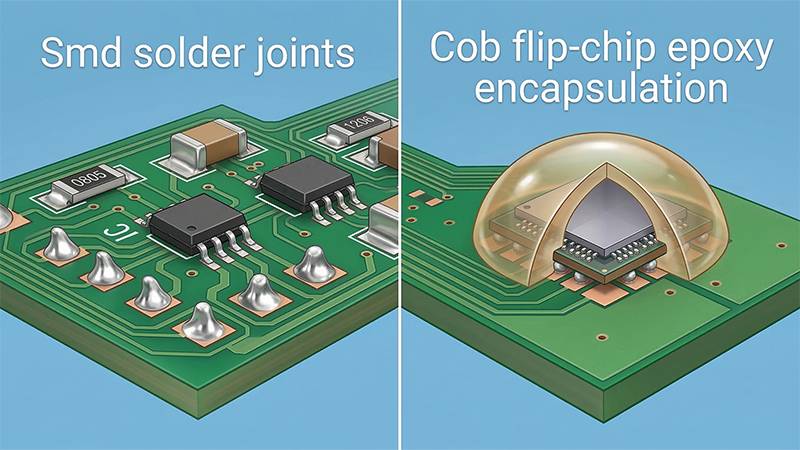 [ Seção transversal de embalagem microscópica ]
2. SMD vs.. Comparação de desempenho COB
Indo além dos termos de marketing, aqui está o desempenho das duas tecnologias em seis testes críticos de estresse ambiental e visual:
-
🛡️ Durabilidade Física & Proteção
SMD: Altamente suscetível a choques físicos. Um leve arranhão no equipamento pode desalojar pixels, levando a imediato “luz morta” manutenção.
ESPIGA: Resiliência de nível militar. O revestimento de resina fornece 5X a resistência ao impacto do SMD. É naturalmente à prova d'água IP65 na frente, à prova de poeira, e antiestático. -
👁️ Conforto Visual & Qualidade óptica
SMD: A luz de fonte pontual pode causar cansaço visual significativo em salas de controle ou salas de aula. As câmeras captam facilmente padrões moiré (linhas onduladas) das grades de pixels.
ESPIGA: Oferece um efeito difuso, luz de superfície macia. Elimina o brilho, reduz a fadiga ocular para 24/7 operadores, e é 100% sem moiré para estúdios de transmissão. -
🌡️ Gestão Térmica (Dissipação de Calor)
SMD: O calor fica preso dentro do copo de plástico e deve percorrer um longo caminho através das pernas de solda. As telas ficam visivelmente mais quentes.
ESPIGA: Porque os chips estão ligados diretamente ao PCB, o calor é transferido instantaneamente para a placa, reduzindo a temperatura central e prolongando a vida útil da tela.
3. Insights de fabricantes de displays
Para garantir que você esteja totalmente equipado, devemos discutir as realidades de fabricação do COB. É uma tecnologia premium, mas tem armadilhas específicas que os fornecedores não verificados não mencionarão.
- O “Cor da tinta” Armadilha de Consistência: Porque os painéis COB são revestidos com resina, alcançar exatamente o mesmo tom de preto em centenas de módulos é notoriamente difícil. Se você comprar de um fornecedor barato, sua tela parecerá uma colcha de retalhos quando desligada. Solução: Exija calibração óptica rigorosa e entrega de lote único.
- A realidade do reparo: Se um pixel SMD morrer, um técnico local pode soldar um novo $0.10 lâmpada em minutos. Se um pixel COB morrer, não pode ser consertado no local. Você deve trocar o módulo inteiro e enviá-lo de volta para a fábrica. Embora o COB falhe com muito menos frequência (sob 10 PPM), quando isso acontece, a logística é mais pesada.
4. Exibir seleção de densidade de pixel
Sua densidade de pixel necessária (a distância entre os LEDs) determinará em grande parte qual tecnologia você deve comprar. Use a estrutura deste fabricante:
5. Análise de custos de aquisição de tela de exibição
Compradores amadores olham a fatura inicial; compradores profissionais analisam o TCO de 3 anos. Devido à sua eficiência energética superior (Flip-Chip) e manutenção quase zero, O COB muitas vezes paga seu prêmio inicial dentro 24 meses.
| Métrica Financeira (3-Período do ano) | Exemplo de LED SMD | Exemplo de LED COB | Vencedor Financeiro |
|---|---|---|---|
| CapEx inicial de hardware | Custo da linha de base | Prêmio (15-20% Mais alto) | SMD |
| Energia / OpEx de HVAC | Sorteio Padrão & Aquecer | Até 30% Poupança | ESPIGA |
| Manutenção & Tempo de inatividade | Alto (Soldagem de pixels) | Perto de zero | ESPIGA |
| Degradação da vida útil | Perceptível depois 3-4 anos | Altamente estável & selado | ESPIGA |
6. Veredicto Final: Qual você deve comprar?
- Outdoors e fachadas
- Estágio, Passeio, e eventos de aluguel (Curvatura flexível e reparo em campo)
- Grandes Auditórios (Distância de visualização > 15 pés)
- Orçamentos de capital iniciais estritamente restritos
- Controle de Missão Crítica & Centros de Comando
- Salas de reuniões corporativas de alto padrão & Estúdios de TV
- Zonas interativas, escolas, e museus (Seguro ao toque)
- Projetos que exigem arremessos ultrafinos (Abaixo de P1.2)
Precisa de aconselhamento especializado para o seu projeto arquitetônico específico?
Como fabricante direto, nossa equipe de engenharia pode fornecer gratuitamente, personalizado Cálculo do TCO e recomende a densidade de pixels ideal para o seu espaço,Contate nosso departamento técnico hoje.