1. The Paradigm Shift in Fine Pixel Pitch
In the rapidly evolving landscape of Large Format Displays (LFD), the transition from Surface Mounted Device (SMD) technology to Chip-on-Board (COB) marks a significant technological leap. For decades, SMD has been the industry workhorse, offering modularity and a mature supply chain. However, as demand for ultra-fine pixel pitches (below P1.2mm) grows in corporate boardrooms, command centers, und Rundfunkstudios, the limitations of SMD—fragility, heat dissipation, and optical graininess—have become more apparent.
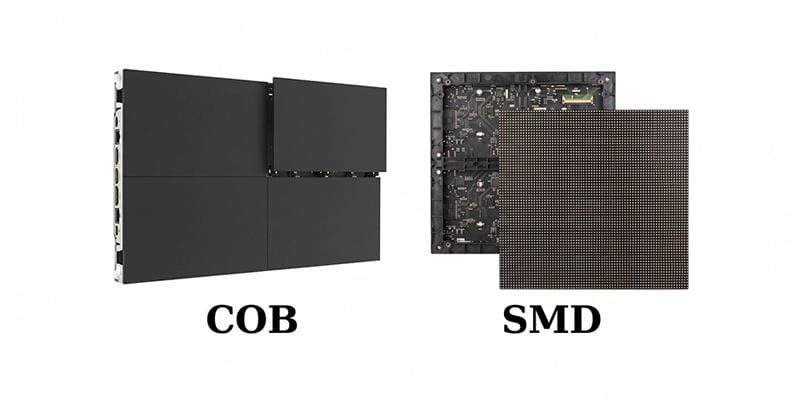
2. Decoding SMD vs. COB Packaging
Understanding the fundamental packaging differences is essential to appreciating their divergent performance characteristics. Both technologies achieve the goal of RGB color mixing, but their physical integration methods differ vastly.
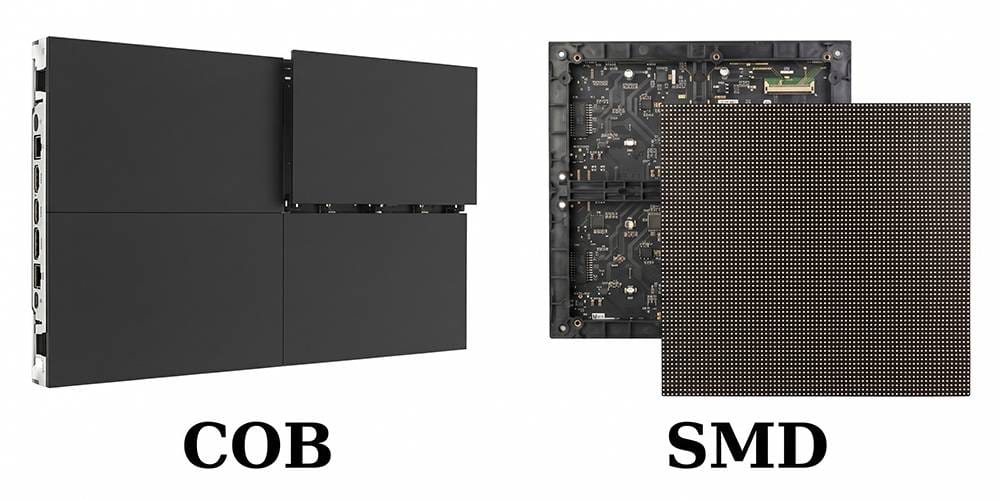
2.1 SMD (Surface Mounted Device)
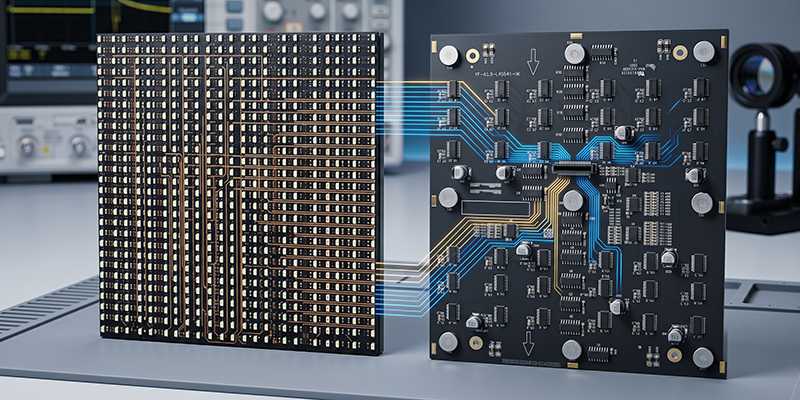
SMD technology involves mounting individual LED “lamps” onto a PCB surface. Each lamp contains the Red, Green, and Blue (RGB) chips encapsulated in a plastic casing.
Advantage:High repairability at the single-pixel level.
Disadvantage:The “point source” of light creates high glare, and the physical gaps between lamps are prone to damage from touch or humidity.
2.2 COB (Chip-on-Board)
COB eliminates the plastic casing entirely. RGB chips are bonded directly to the PCB and then covered with a protective transparent resin coating.
The Flip-Chip Revolution: Modern COB often uses “Flip-Chip” technology, removing the gold wire bonding of traditional LEDs. This increases the luminous area and improves heat dissipation significantly.
3. Optics, Contrast, and Visual Comfort
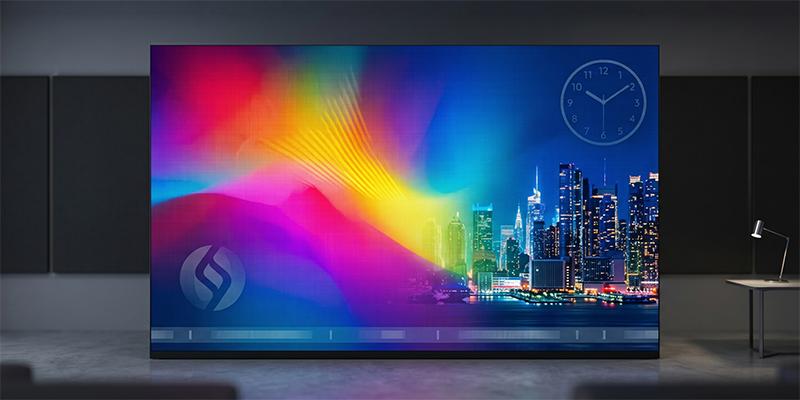
One of the primary advantages of COB is the Surface Light Source effect. Unlike SMD, which emits light from millions of distinct points, COB emits a more uniform, diffused light. For high-end conference rooms where participants sit close to the screen for hours, COB significantly reduces “Moiré patterns” and eye strain.
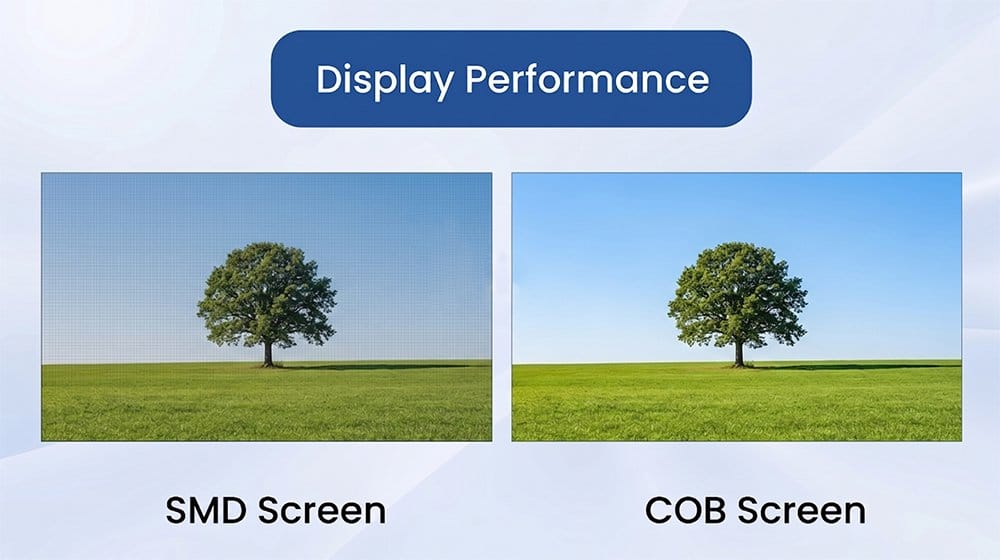
| Parameter | Traditional SMD | Advanced COB (Flip-Chip) |
|---|---|---|
| Contrast Ratio | Low to Moderate (3,000:1) | Ultra High (10,000:1 – 20,000:1) |
| Surface Finish | Matte/Grainy (Plastic cases) | Full Surface Resin (Deep Black) |
| Light Emission | Point Source (High Eye Fatigue) | Surface Source (Soft Light) |
| Viewing Angle | 140° – 160° | 170°+ (Near Perfect) |
4. The Reliability Factor
SMD displays are notoriously fragile. A single accidental bump can dislodge an LED lamp, leading to costly on-site repairs. COB displays are inherently protected by their resin encapsulation, often referred to as “5-Fold Protection”:
- Waterproof:The surface can be wiped with a damp cloth.
- Dustproof:No gaps for particles to enter the circuitry.
- Anti-static:Reduced risk of ESD damage during handling.
- Anti-collision:High resistance to physical impact.
- Anti-oxidation:Enclosed chips prevent humidity-induced failure.
5. Choosing the Right Tech for the Right Room
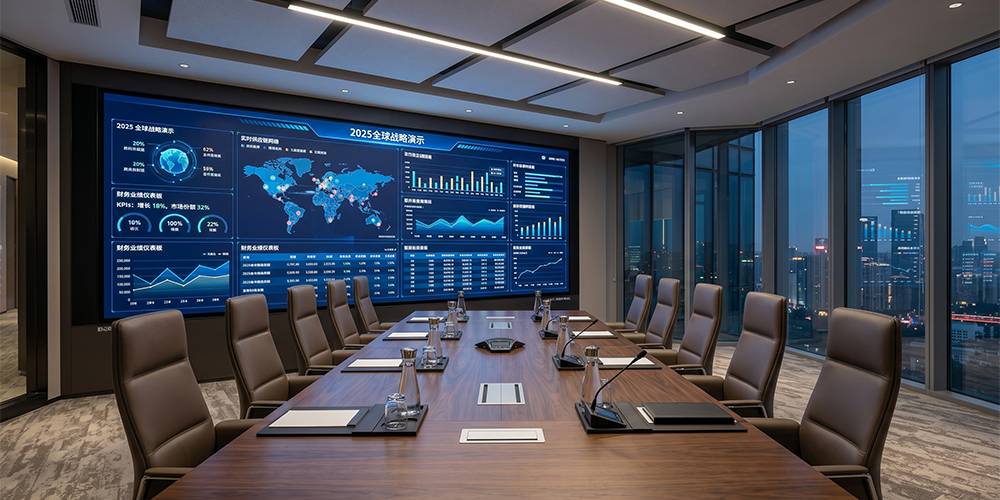
Corporate Conference Rooms (COB Recommended)
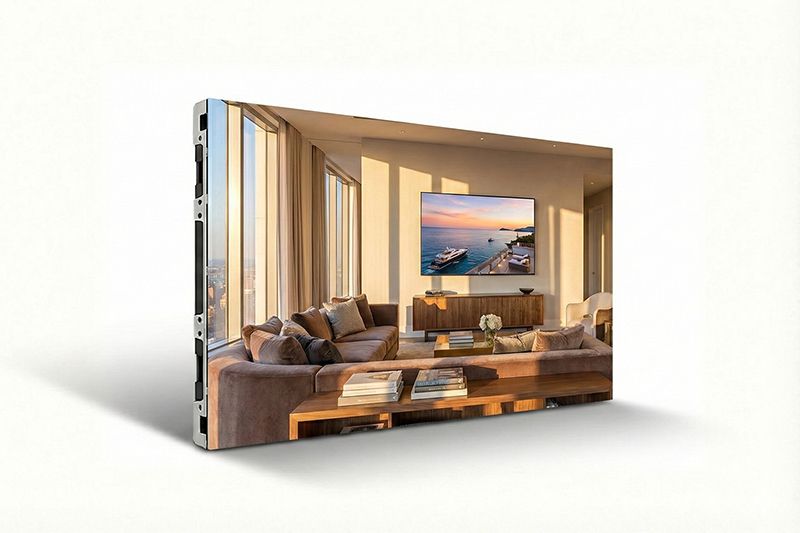
In high-end meeting rooms, touch interaction and visual clarity for detailed spreadsheets or 4K video are paramount. COB’s P0.9 and P1.2 solutions offer the “Retina” experience similar to consumer TVs but on a massive scale.
Broadcast and TV Studios (COB Recommended)
The anti-Moiré properties of COB make it superior for on-camera performance. The matte finish options prevent studio lights from reflecting off the screen surface.
Public Advertising & Large Arenas (SMD Recommended)
For viewing distances over 5 meters and pixel pitches above P1.8, SMD remains more cost-effective. The modular nature allows for quick panel swaps in high-traffic environments where absolute visual perfection is less critical than scale.
6. Total Cost of Ownership (TCO) & Maintenance Analysis
The ROI Calculation:While COB has a higher initial CAPEX (approximately 20-30% higher than SMD for similar pitch), its OPEX is significantly lower.
Failure Rates:SMD typically sees a failure rate of 30-50 Parts Per Million (PPM). Advanced Flip-Chip COB can achieve < 5 PPM. This translates to fewer service calls and a lifespan that reliably exceeds 100,000 hours without the “Swiss cheese” look of dead pixels often seen in aging SMD walls.
7. Conclusion: Which Technology Wins for Your Project?
The verdict is clear:
- Choose COB if your project demands high-end aesthetics, touchability, eye comfort for long viewing sessions, and a pixel pitch below P1.2mm. It is the future-proof choice for high-stakes environments.
- Choose SMD for budget-sensitive projects with larger viewing distances where the pixel pitch is P1.5 or higher and modular repairability is a logistical preference.