As the demand for ultra-high-definition, fine-pitch visual experiences grows, traditional LED packaging technologies are hitting their physical limits. Enter COB (Chip-on-Board) LED technology—a revolutionary approach that is rapidly becoming the gold standard for high-end commercial, broadcast, and command center video walls.
Whether you are an AV integrator, a corporate buyer, or a stage designer, understanding the mechanics, true advantages, and potential pitfalls of COB technology is critical. This comprehensive guide goes beyond the surface to help you make an informed, authoritative decision for your next display project.
1. What Exactly is a COB LED Display?
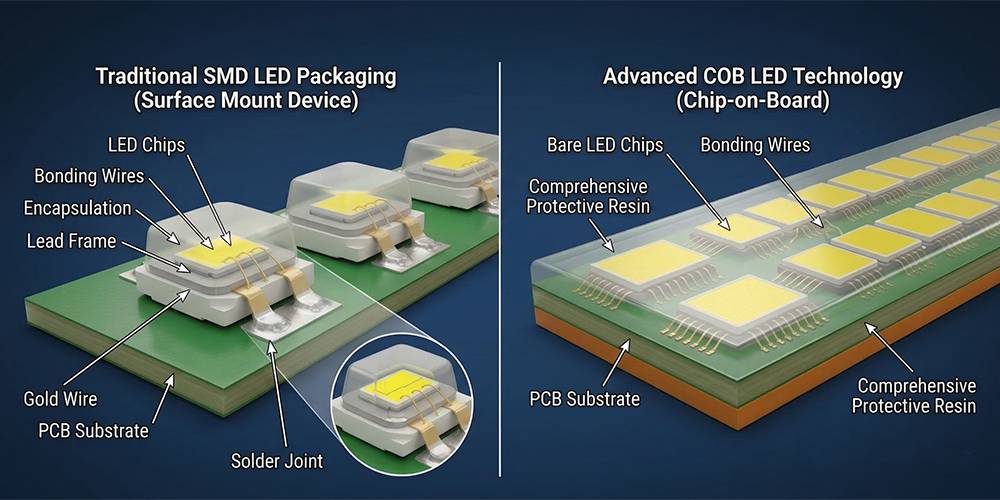
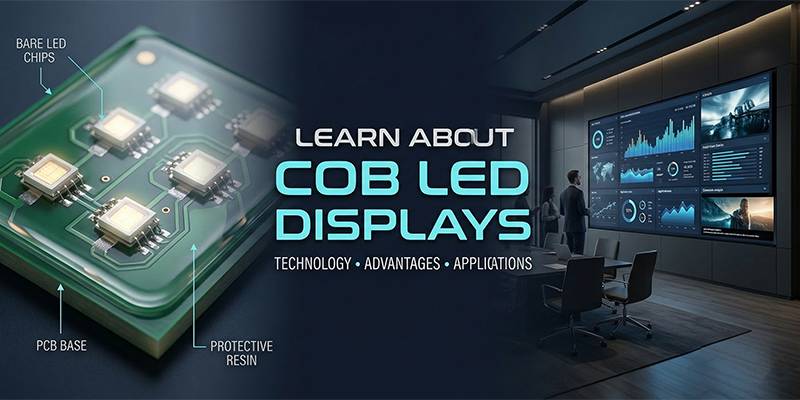
To understand COB, we must look at how it differs from traditional SMD (Surface Mount Device) screens. In an SMD display, individual LED chips are first encapsulated into tiny plastic or ceramic brackets (the “beads”), which are then surface-soldered onto a printed circuit board (PCB).
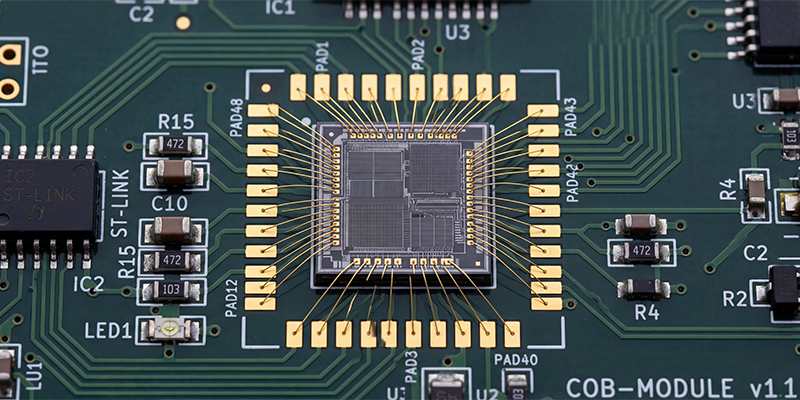
COB (Chip-on-Board) eliminates the middleman. The bare LED chips are directly mounted and bonded onto the PCB. Once the chips are placed, the entire board is sealed with a specialized epoxy resin. This “bracket-less” and “pin-less” design removes physical barriers, allowing manufacturers to achieve incredibly tight pixel pitches (below P1.0) while fundamentally changing the screen’s physical and optical properties.
2. Why Industry Leaders Choose COB
The architectural shift of directly mounting chips to the board yields several transformative benefits that traditional SMD screens simply cannot match:
Unmatched Durability and Protection
Because the LED chips are completely encased in a hardened epoxy resin, the surface of a COB display is smooth, robust, and highly resilient.
Impact Resistant: It can withstand bumps, scratches, and direct impacts that would easily shear off SMD pixels.
All-Weather Reliability: The solid encapsulation makes it inherently moisture-proof, dust-proof, anti-static, and highly resistant to oxidation. You can literally wipe a COB screen clean with a damp cloth.
Superior Visual Comfort (The “Surface Light Source”)
Traditional SMD LEDs emit light as distinct “point sources,” which can be harsh on the eyes during prolonged viewing and often cause moiré patterns on camera. The resin coating on a COB display diffuses the light, transforming it into a “surface light source.” This creates a softer, more uniform image that drastically reduces eye fatigue, making it perfect for conference rooms and close-proximity viewing.
Extreme Contrast and Deep Blacks
High-quality COB panels boast an exceptionally high black-fill ratio on the screen surface. When the screen is off, it presents a deep, uniform ink-black appearance. When illuminated, this translates to breathtaking contrast ratios, vibrant color reproduction, and rich shadow details.

Exceptional Heat Dissipation
Heat degrades LED lifespan. In SMD displays, heat must travel through the packaging bracket before reaching the board. In a COB layout, the bare chips are in direct contact with the PCB, allowing heat to dissipate rapidly through the board’s copper layers. This thermal efficiency significantly extends the display’s lifespan and virtually eliminates “dead pixels” over time.
3. Limitations and Considerations
To make a truly informed decision, it is essential to look at the challenges associated with COB technology. Transparency regarding these limitations is what separates professional planning from costly mistakes.
Higher Initial Investment: The manufacturing process for COB requires advanced cleanrooms and ultra-high-precision die-bonding equipment. Consequently, the upfront cost of a COB video wall is higher than a standard SMD equivalent.
Complex On-Site Maintenance: If an SMD pixel dies, a technician can use a soldering iron to replace that single bead on-site. Because COB panels are sealed in resin, you cannot easily replace a single chip. Faulty modules typically need to be swapped out entirely and sent back to the factory for specialized laser repair.
Surface Ink Color Consistency: In the past, achieving a perfectly uniform black resin coating across multiple modules was difficult, sometimes resulting in a slight checkerboard effect (optical color difference) under strong ambient light. Expert Note: Modern manufacturers utilizing the latest “Flip-Chip COB” technology and advanced calibration have largely solved this issue, but it remains a crucial metric to check when evaluating suppliers.
4. COB vs. SMD LED Displays
| Feature | COB LED Display | SMD LED Display |
|---|---|---|
| Packaging Method | Chips directly on PCB, fully sealed in resin. | Individual chips in brackets, surface-soldered. |
| Pixel Pitch Target | Ultra-fine (P0.4 to P1.5). Ideal for 4K/8K. | Fine to standard (P1.2 and above). |
| Physical Protection | Extremely high (water, dust, impact resistant). | Vulnerable (pixels can be knocked off easily). |
| Light Emission | Surface light source (soft, anti-glare). | Point light source (sharp, can cause eye strain). |
| Maintenance | Module replacement; factory repair required. | Individual pixel replacement possible on-site. |
| Production Cost | Higher due to complex precision manufacturing. | Lower, mature mass-production technology. |
5. Top Applications for Micro-Pitch COB Screens
Given its unique characteristics, COB technology provides the highest return on investment in environments that demand flawless visuals and high reliability:
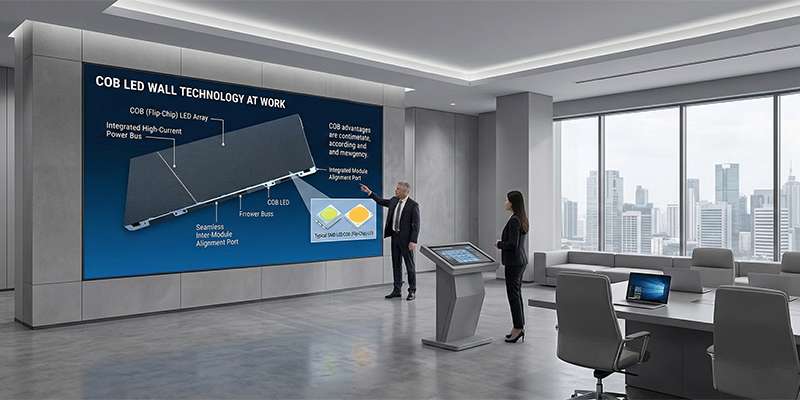
Executive Boardrooms & Conference Centers: Replaces traditional LCD video walls (which have ugly bezels) and projectors (which lack brightness). The anti-glare, soft light emission keeps attendees comfortable during long meetings.
Broadcast Studios & XR Virtual Production: The high refresh rates and elimination of moiré effects make COB screens the perfect dynamic backdrop for high-definition camera lenses.
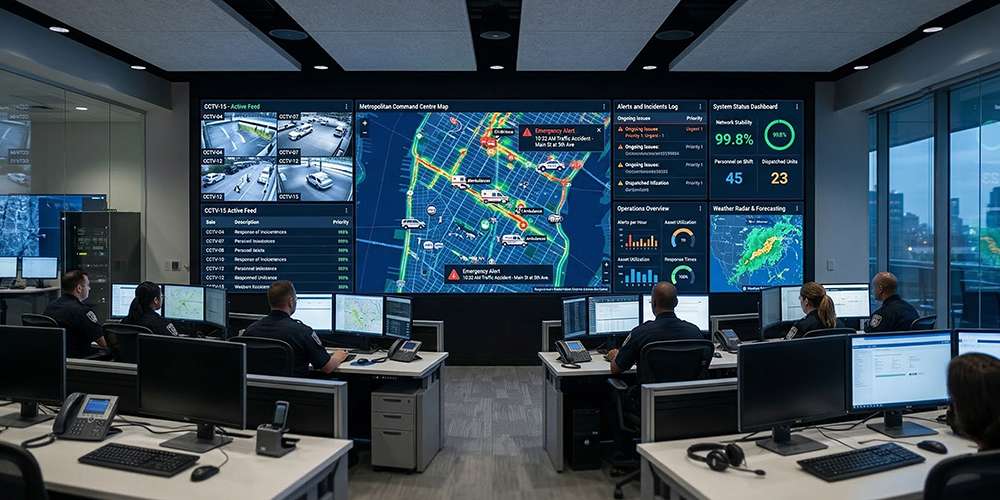
Command, Control, and Dispatch Centers: In environments requiring 24/7 continuous operation, the ultra-low failure rate and superior heat dissipation of COB ensure mission-critical data is never interrupted.
Luxury Retail & High-End Exhibitions: The ability to withstand public interaction (due to high impact resistance) while delivering stunning, bezel-free visuals makes it ideal for flagship stores and museums.
6. Why Video Proof Matters
When investing in high-end visual technology, static images and spec sheets simply don’t tell the whole story. To truly evaluate a COB LED video wall’s refresh rate, grayscale transitions, low-light performance, and off-axis viewing angles, dynamic video testing is absolutely essential.
Real-world video footage allows you to witness how the screen handles fast motion without ghosting, how seamlessly the modules align, and how the panel reacts to ambient light.
To help you thoroughly vet the technology, we highly recommend exploring detailed, unedited video demonstrations of the panels in action. Seeing the installation process, the macro-level pixel structure, and various content types playing on the screen will give you the confidence that the technical specifications translate to real-world perfection.
(If you are evaluating our specific panel models, please refer to our comprehensive video library for rigorous performance stress-tests and installation guides.)
7. Conclusion
COB LED technology is not just an incremental upgrade; it is a structural revolution in the LED display industry. By eliminating the fragile encapsulation of the past, it delivers a robust, visually stunning, and highly reliable display solution tailor-made for the micro-pitch era.
While the initial cost is higher and the maintenance requires module-level replacement, the long-term benefits in durability, visual comfort, and breathtaking image quality make COB the definitive choice for premium indoor applications. When selecting your display, prioritize manufacturers who offer transparent technical data, utilize the latest flip-chip designs, and can provide extensive video proof of their screen’s real-world performance.
Would you like me to help draft specific technical descriptions for the videos you plan to showcase alongside this article?